
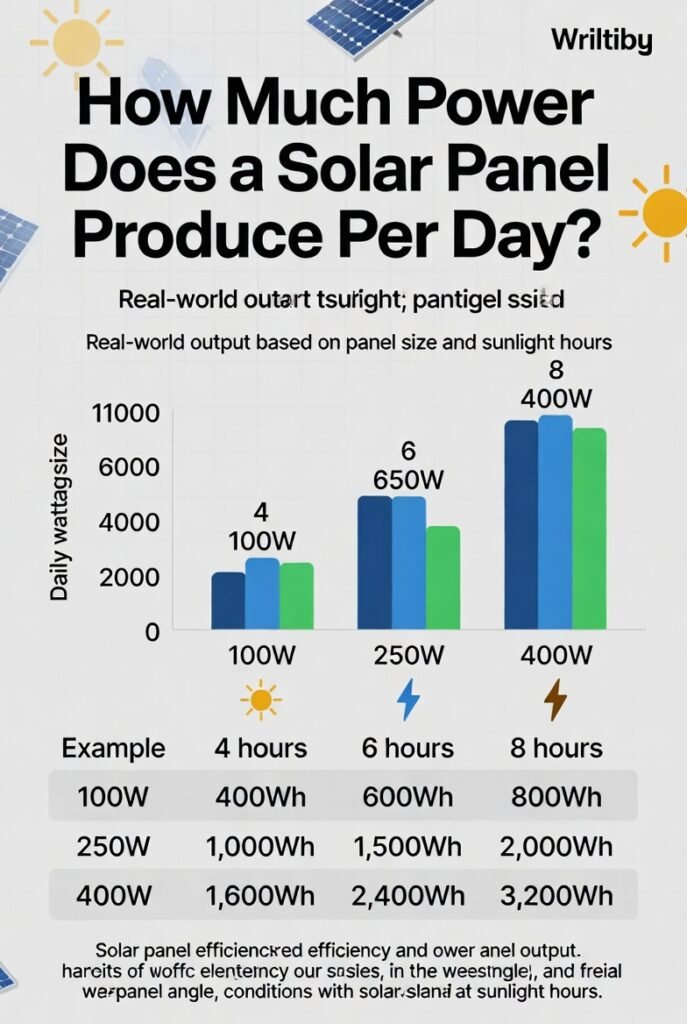
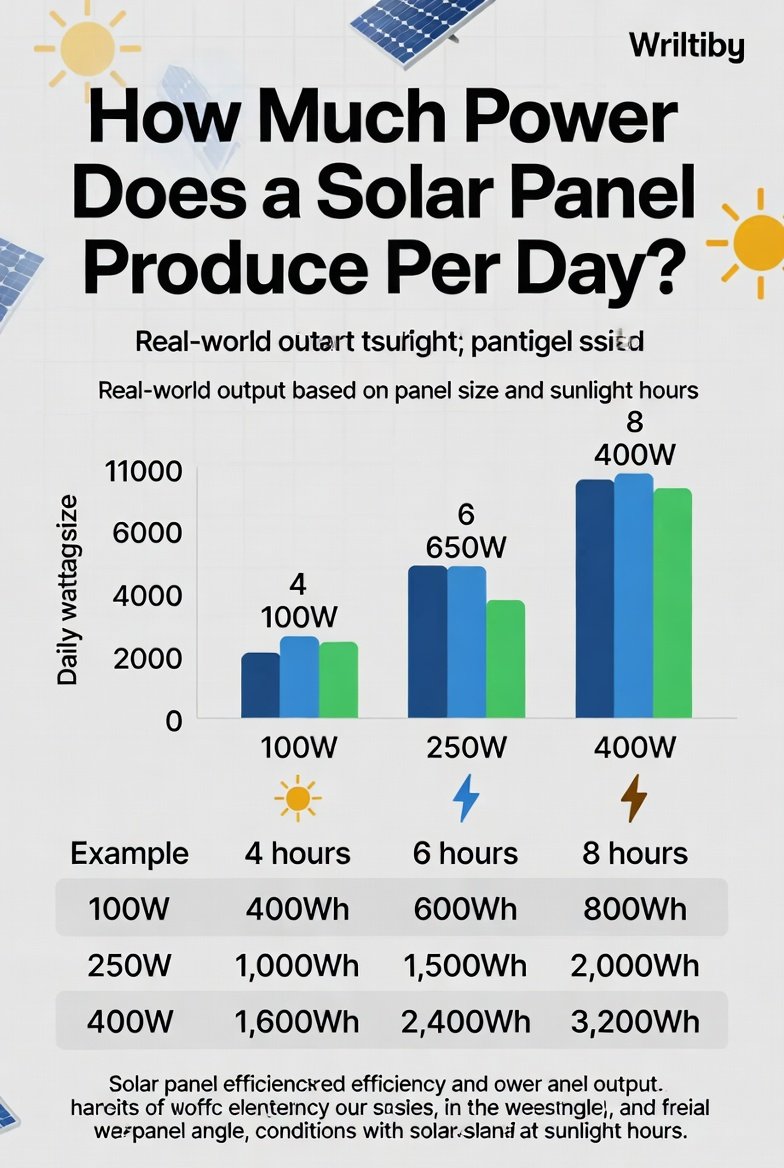
How Much Power Does a Solar Panel Produce Per Day?
One of the most common questions homeowners ask when researching solar energy is how much electricity a solar panel can actually produce each day.
Solar panels are rated using wattage, but real electricity production depends on several variables including sunlight exposure, geographic location, panel efficiency, and installation conditions.
In most residential systems, a modern solar panel generates between 1.5 and 2.5 kilowatt-hours (kWh) of electricity per day.
Understanding daily solar production helps homeowners estimate how many panels are required to power a home and how much electricity solar energy can offset from the utility grid.
This guide explains:
- Typical solar panel electricity production per day
• How panel wattage affects power generation
• How peak sun hours determine output
• How many panels are needed for a home
• Real-world solar production examples
If you want to estimate system size for your home, see:
solar-system-sizing-calculator
Typical Solar Panel Output Per Day
Most residential solar panels today fall between 350 watts and 450 watts in rated capacity.
However, solar panels rarely operate at their maximum output continuously. Instead, electricity production depends on sunlight intensity throughout the day.
Typical daily solar panel production ranges include:
Panel Size | Daily Output | Monthly Output |
350W panel | 1.4 – 1.8 kWh | 42 – 54 kWh |
400W panel | 1.6 – 2.2 kWh | 48 – 66 kWh |
450W panel | 1.8 – 2.5 kWh | 54 – 75 kWh |
For example, a 400-watt solar panel installed in a location with five peak sun hours can generate roughly 2 kWh of electricity per day.
Over the course of a year, that panel may generate 600–750 kWh of electricity depending on climate conditions.
What Are Peak Sun Hours?
Solar electricity production is commonly estimated using the concept of peak sun hours.
Peak sun hours measure the amount of solar energy received in a location over the course of a day. Instead of counting daylight hours, peak sun hours represent the number of hours when solar radiation averages approximately 1,000 watts per square meter.
Typical sunlight conditions across the United States include:
Region | Average Peak Sun Hours |
Pacific Northwest | 3 – 4 hours |
Midwest | 4 – 4.5 hours |
Southern states | 4.5 – 5 hours |
Southwest (Arizona, Nevada) | 5 – 6 hours |
Regions with stronger sunlight naturally produce higher solar electricity output.
Solar Panel Output Calculation Formula
Solar energy production can be estimated using a simple formula:
Daily Solar Output = Panel Wattage × Peak Sun Hours × System Efficiency
Example:
400W panel × 5 peak sun hours × 0.85 system efficiency = 1,700 watt-hours per day
Which equals approximately 1.7 kWh of electricity per day.
The efficiency factor accounts for energy losses caused by:
- inverter conversion
• wiring resistance
• temperature changes
• system inefficiencies
Most residential solar systems operate at roughly 80–90% real-world efficiency.
Solar Panel Efficiency Types
Different solar panel technologies produce electricity at different efficiency levels.
The three most common solar panel types include:
Panel Type | Efficiency | Typical Use |
Monocrystalline | 18–22% | Most residential systems |
Polycrystalline | 15–17% | Budget installations |
Thin-film | 10–13% | Commercial or specialty uses |
Monocrystalline panels dominate modern residential solar installations because they offer the highest efficiency and produce more electricity within limited roof space.
Polycrystalline panels are less expensive but slightly less efficient, while thin-film panels are typically used in large commercial installations rather than residential rooftops.
Solar Panel Output by Wattage
Solar panel wattage directly influences daily electricity production.
Panel Wattage | Daily Production | Annual Production |
300W | 1.2 – 1.6 kWh | 438 – 584 kWh |
350W | 1.4 – 1.8 kWh | 511 – 657 kWh |
400W | 1.6 – 2.2 kWh | 584 – 803 kWh |
450W | 1.8 – 2.5 kWh | 657 – 912 kWh |
Higher-efficiency panels increase energy production when roof space is limited.
How Many Solar Panels Power a Home?
The number of solar panels needed for a home depends primarily on electricity consumption.
The average household in the United States uses roughly 900 to 1,000 kWh of electricity per month.
Typical system sizes include:
System Size | Monthly Output | Panels Needed |
6 kW system | 700 – 900 kWh | 15 – 18 panels |
8 kW system | 900 – 1,200 kWh | 20 – 24 panels |
10 kW system | 1,200 – 1,500 kWh | 25 – 30 panels |
Homes with electric heating, electric vehicles, or large air-conditioning systems may require larger solar arrays.
To estimate system pricing, see:
solar-panel-system-cost
Do Solar Panels Lose Power Over Time?
Solar panels gradually lose efficiency as they age.
Most manufacturers estimate a degradation rate of about 0.5% per year.
This means a solar panel may still produce approximately 85–90% of its original output after 25 years of operation.
High-quality solar panels typically include 25-year performance warranties, guaranteeing a minimum production level after decades of use.
How Temperature Affects Solar Panel Output
Solar panels actually lose efficiency as temperatures rise.
While panels require sunlight to generate electricity, excessive heat can reduce performance.
Most solar panels lose approximately 0.3–0.5% efficiency for every degree Celsius above 25°C (77°F).
This means extremely hot conditions can slightly reduce solar panel output, although strong sunlight usually compensates for these losses.
Modern solar panels are designed to maintain stable performance across a wide range of environmental conditions.
Real Solar System Production Example
Consider a homeowner installing an 8 kW solar system using 400-watt panels.
System configuration:
- 20 solar panels
• 5 peak sun hours
• 85% system efficiency
Estimated daily production:
20 × 400W × 5 × 0.85
= 34 kWh per day
Monthly production:
≈ 1,020 kWh
This level of electricity production can offset most household electricity usage depending on local energy consumption.
To estimate financial savings from solar energy, see:
solar-panel-return-on-investment
Solar Battery Storage and Daily Production
Some homeowners install solar batteries to store excess electricity produced during the day.
Solar batteries allow homeowners to:
- store excess solar energy
• use stored electricity at night
• maintain power during grid outages
However, battery storage increases overall installation costs.
For a full breakdown, see:
solar-battery-cost
Key Takeaways: Solar Panel Power Production
Most modern residential solar panels generate between 1.5 and 2.5 kWh of electricity per day depending on sunlight conditions and panel efficiency.
Solar electricity generation depends on several important variables:
- panel wattage
• geographic location
• peak sunlight hours
• system efficiency
• installation orientation
Understanding these factors helps homeowners estimate solar system output and determine how many panels are required to meet household electricity demand.
According to research from the U.S. Department of Energy and the National Renewable Energy Laboratory (NREL), residential solar systems continue to improve in efficiency and cost effectiveness, making solar power an increasingly practical option for homeowners.
Frequently Asked Questions
How much electricity does a solar panel produce per day?
Most residential solar panels produce 1.5 to 2.5 kWh per day depending on sunlight exposure and panel wattage.
How many solar panels are needed for a house?
Most homes require 20–30 solar panels depending on electricity consumption and system efficiency.
Do solar panels work on cloudy days?
Yes. Solar panels still generate electricity during cloudy conditions, although output may drop to 20–40% of normal production.
How many kWh does a 400-watt solar panel produce per day?
A 400-watt solar panel typically produces 1.6–2.2 kWh per day depending on sunlight hours and installation conditions.