
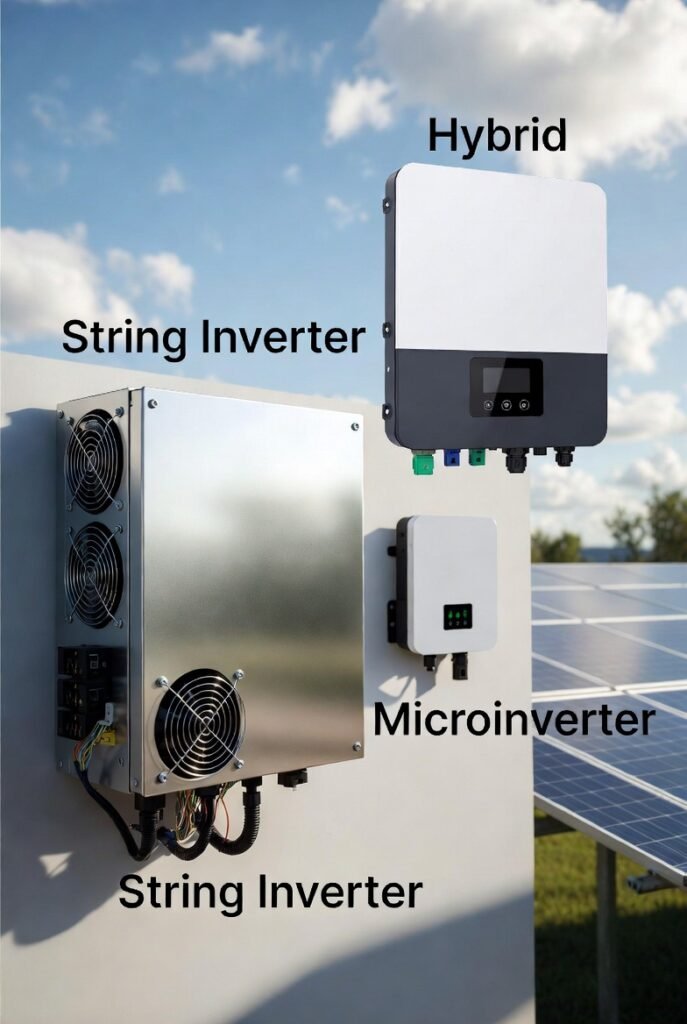
Solar Inverter Types
Solar panels generate electricity.
But inverters make that electricity usable.
Without an inverter, solar power cannot safely run your home.
Yet many homeowners spend weeks comparing panel brands…
…and barely ask about the device that actually controls energy conversion.
That is a strategic blind spot.
Because inverter choice influences:
✔ system efficiency
✔ outage behavior
✔ monitoring visibility
✔ maintenance exposure
✔ long-term reliability
This guide explains the major inverter architectures, where each excels, and how to evaluate them like an infrastructure decision — not a gadget purchase.
No marketing hype. No brand pushing. Just engineering clarity.
Executive Snapshot (Start Here)
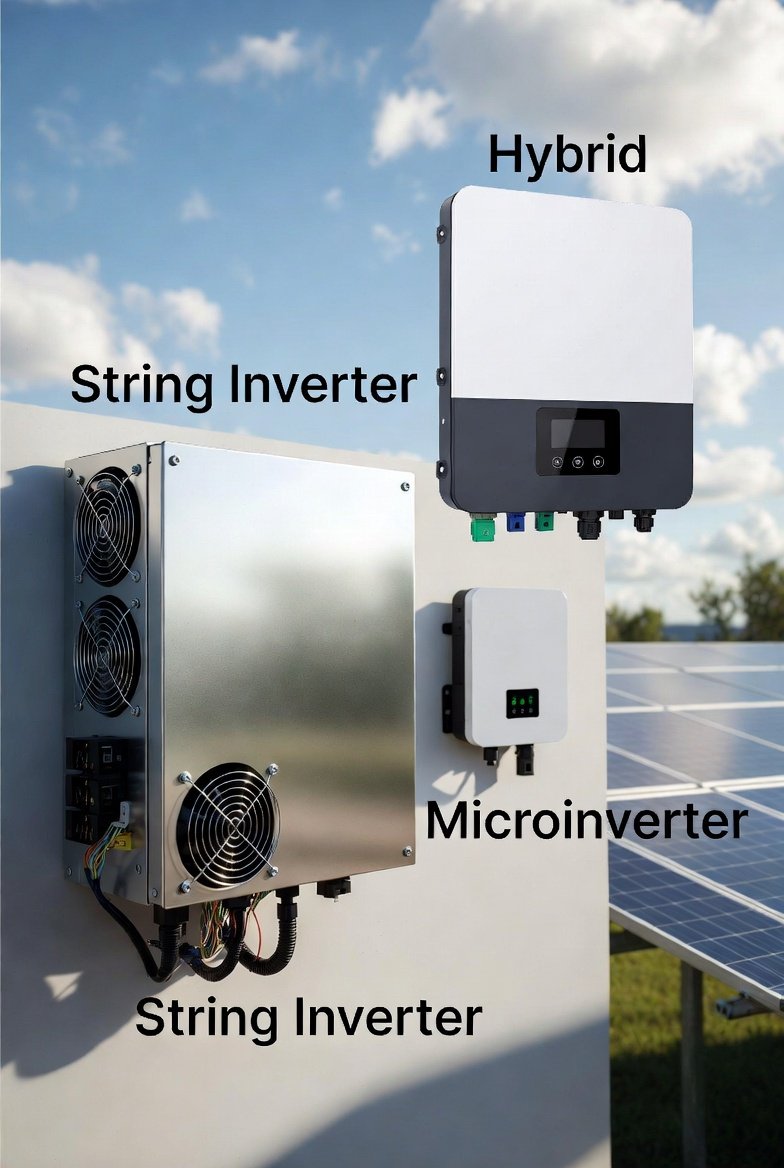
Most residential systems rely on one of three architectures:
👉 String inverters — centralized and cost-efficient
👉 Microinverters — panel-level optimization
👉 Hybrid inverters — battery-ready flexibility
None is universally “best.”
The correct choice depends on roof design, shading, budget, and long-term energy strategy.
A Quick Reality Check Many Buyers Miss
Panels produce DC power.
Homes run on AC power.
The inverter performs that conversion continuously — often for decades.
Which means:
👉 Inverters are not accessories.
👉 They are operational infrastructure.
Quietly, they are one of the most important reliability components in the entire system.
How the Inverter Fits Into Your Energy Flow
Think of your solar setup as a chain:
Solar panels → inverter → electrical panel → home usage → grid (if connected)
When the inverter performs well, the system performs well.
When it struggles — production suffers.
Simple.
The Three Core Solar Inverter Types
Let’s break them down clearly.
✔ String Inverters — Proven, Centralized Design
String inverters connect multiple panels into a single circuit (“string”) that feeds one conversion point.
Why homeowners choose them:
✔ typically lower upfront cost
✔ long operational history
✔ straightforward installation
✔ reliable in uniform sunlight
Where caution is needed:
⚠ shading on one panel can influence output across the string
⚠ expansion flexibility may be limited
Best suited for:
👉 roofs with consistent sun exposure
👉 simpler layouts
👉 cost-sensitive projects
Sometimes the simplest engineering wins.
✔ Microinverters — Panel-Level Intelligence
Microinverters attach directly beneath individual panels.
Each panel operates independently.
Advantages:
✔ shading affects only the impacted panel
✔ production visibility improves
✔ design flexibility increases
✔ performance often stabilizes across complex roofs
Tradeoffs:
⚠ higher equipment cost
⚠ more electronic components on the roof
Ideal for:
👉 partial shade environments
👉 multi-angle roofs
👉 homeowners prioritizing performance insight
Granular control often appeals to technically minded buyers.
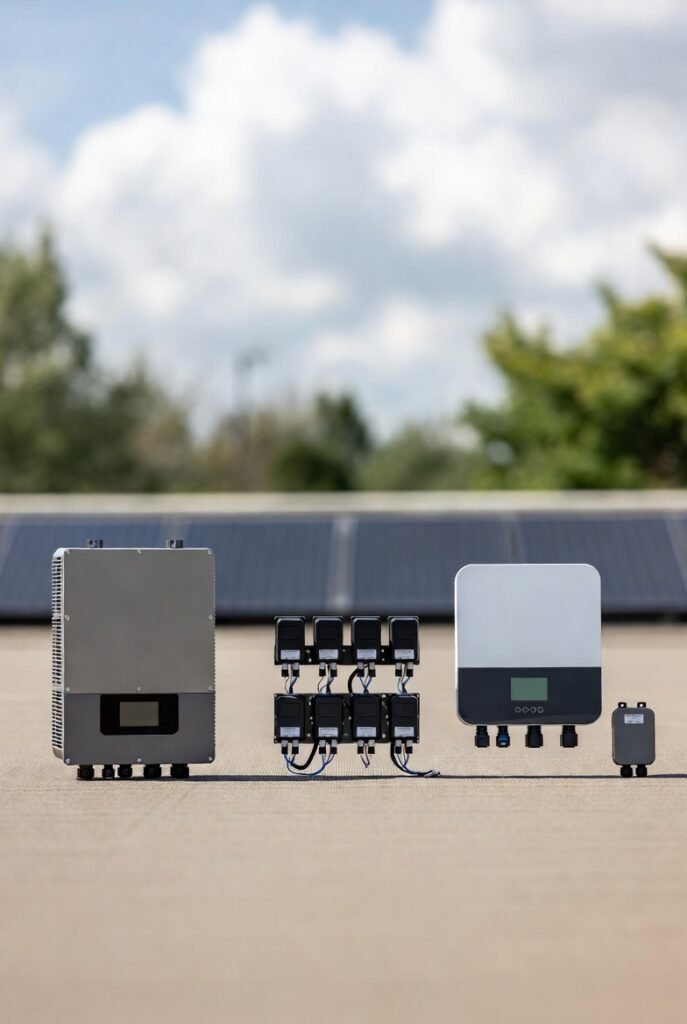
✔ Hybrid Inverters — Storage-Ready Architecture
Hybrid inverters integrate solar generation with battery compatibility.
This design simplifies future storage adoption.
Strengths:
✔ battery-ready infrastructure
✔ streamlined wiring
✔ future adaptability
Considerations:
⚠ higher upfront investment
⚠ planning complexity
For homeowners even considering backup power, this architecture can reduce later retrofit friction.
If storage is on your radar:
Future-proofing is easier during initial design.
Executive Insight Most Installers Quietly Agree On
There is rarely a universally superior inverter.
There is only:
👉 the inverter that best fits the roof and energy strategy.
Engineering alignment beats brand loyalty every time.
Solar Inverter vs Microinverter — The Decision Lens
Instead of asking “Which is better?” ask:
👉 What conditions exist on my roof?
Condition | Often Favors |
Full sunlight | String inverter |
Mixed shading | Microinverters |
Battery plans | Hybrid |
Budget focus | String |
Performance focus | Micro |
Context drives architecture.
Efficiency — What Actually Matters
Modern inverters frequently operate at high conversion efficiency under typical conditions.
But here is the nuance many miss:
System-level efficiency often depends more on:
- roof geometry
- shading
- system design
than on fractional inverter differences alone.
Avoid chasing decimal points.
Prioritize compatibility.
How to Size a Solar Inverter Correctly
Oversizing and undersizing both introduce inefficiencies.
Engineers typically evaluate:
✔ array capacity
✔ voltage windows
✔ production curves
✔ expansion potential
Sizing is rarely a DIY calculation — and shouldn’t be treated as one.
Professional design protects long-term output.
Reliability — The Lifecycle Conversation
Panels often carry multi-decade performance expectations.
Inverters usually operate on shorter warranty cycles.
Many homeowners plan for at least one inverter replacement across the system lifespan.
That is not a defect.
It is infrastructure reality.
Planning early prevents surprise later.
Maintenance Expectations
Inverters generally require minimal routine attention — but they are active electronics.
Occasional monitoring is wise.
If alerts appear, prompt evaluation protects production continuity.
Neglect rarely improves outcomes.
Troubleshooting Signals Homeowners Should Recognize
While installers handle most technical issues, it helps to notice:
- sudden production drops
- warning indicators
- connectivity failures
- unusual shutdown patterns
Early detection often prevents extended downtime.
Installation Complexity Matters More Than Buyers Think
Inverter architecture influences:
👉 wiring pathways
👉 labor intensity
👉 permitting layers
👉 inspection variables
Understanding the broader installation journey helps anchor expectations:
Good engineering is rarely accidental.
Financial Context — Don’t Evaluate Inverters in Isolation
Component decisions should always tie back to the full system model.
Start with pricing clarity:
Then evaluate ROI:
Hardware choices influence outcomes — but rarely define them alone.
Insurance and Asset Protection
Electronics increase system value.
Coverage alignment is worth confirming:
Infrastructure deserves proportional protection.
Executive Insight Most Homeowners Realize Later
The “best inverter” is not the most expensive one.
It is the one that quietly supports reliable production year after year.
Boring reliability often beats flashy specs.
What This Page Is — And What It Isn’t
This page IS:
- a system architecture guide
- a component decision framework
- a reliability explainer
This page is NOT:
- product advice
- engineering certification
- installation instruction
Design professionals ultimately tailor systems to property conditions.
Where Smart Buyers Go Next
Build your technical clarity in sequence:
👉 Solar Installation Process
👉 Solar Pros and Cons
Confidence compounds when systems are understood — not just purchased.
FAQs
What is the most common solar inverter type?
String inverters remain widely used, though microinverters have gained traction in complex residential installations.
Are microinverters more efficient?
They can improve performance in shaded or irregular layouts, but system design ultimately drives efficiency.
Do solar inverters need replacement?
Many systems anticipate at least one replacement during the broader solar lifecycle.
Is a hybrid inverter worth it?
For homeowners considering battery storage, hybrid designs can simplify future integration.
Can inverter choice affect ROI?
Yes — but typically through system performance rather than dramatic cost swings.