
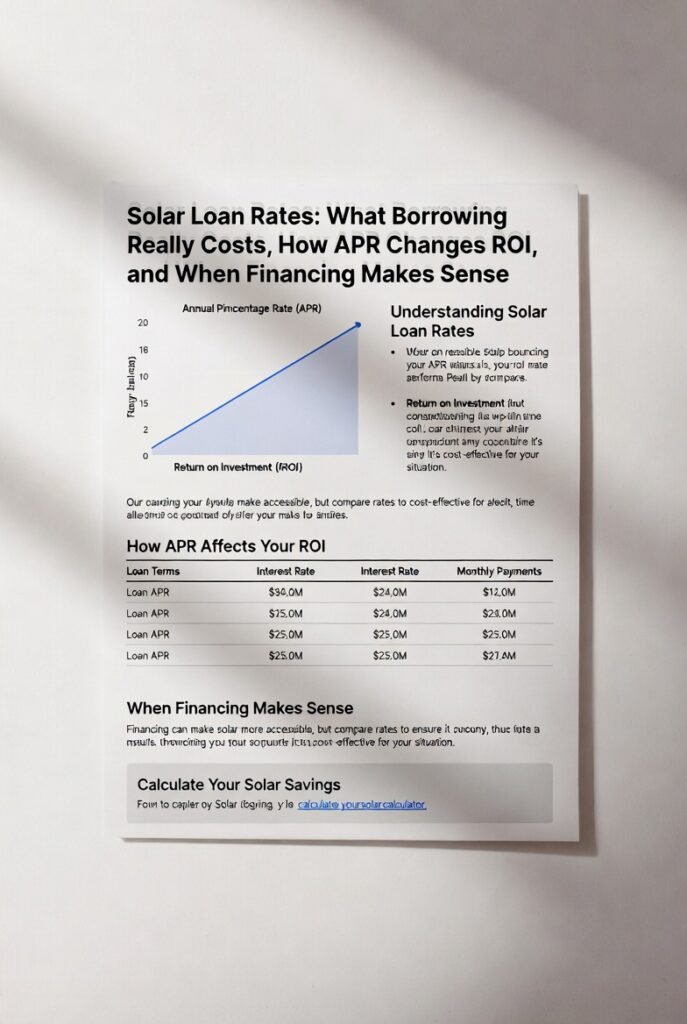
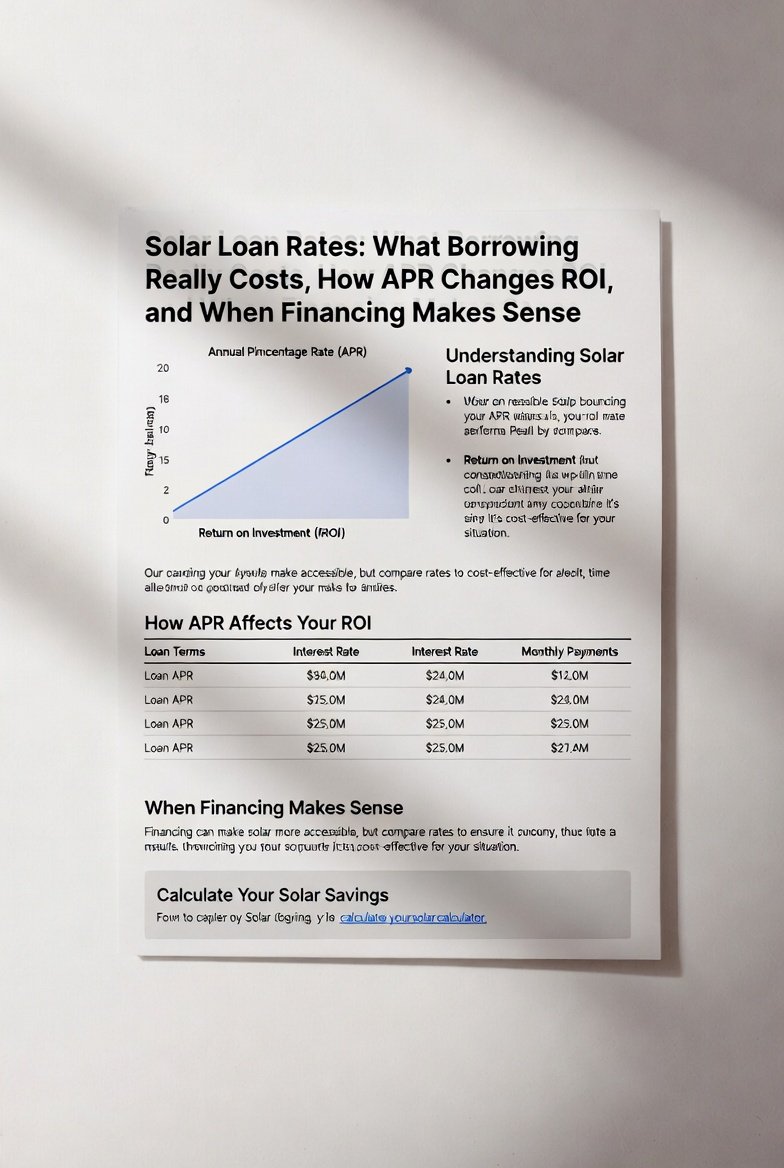
Solar Loan Rates
Solar loan rates don’t just influence your monthly payment.
They determine whether your system becomes a high-performing financial asset… or an expensive long-term obligation.
Two homeowners can install identical systems — yet one builds wealth while the other barely breaks even.
The difference?
👉 Financing structure.
👉 Interest rate.
👉 Loan mechanics.
Understanding this before signing anything is one of the smartest financial moves a solar buyer can make.
This guide explains what solar loans actually cost, how lenders structure them, and when borrowing strengthens — or weakens — your return on investment.
The Fast Reality: Where Solar Loan Rates Typically Land
While rates shift with broader credit markets, many residential solar loans commonly fall within:
👉 ~4% to 9% APR for well-qualified borrowers
But this range alone is misleading.
Because the interest rate you see is often influenced by something buyers rarely notice:
Dealer fees.
We’ll get to those shortly — they matter more than most people realize.
Executive Insight (Anchor This Early)
Solar financing is not just about affordability.
It is about spread — the gap between:
👉 what your system saves
and
👉 what borrowing costs you.
When savings exceed financing costs comfortably, solar behaves like a productive asset.
When the gap narrows?
Returns compress fast.
Why Solar Loans Exist in the First Place
Very few homeowners want to write a $20,000–$30,000 check.
Loans solve that friction.
But they also reshape the financial equation.
A financed system often aims to:
✔ keep payments near your current utility bill
✔ enable ownership
✔ capture incentives
✔ avoid large upfront capital
Ownership is the key differentiator here — unlike leases, the asset is yours.
If you haven’t benchmarked system pricing yet:
Everything starts with cost clarity.
What Actually Determines Your Solar Loan Rate
It isn’t random.
Lenders evaluate risk just like any other consumer loan.
Primary drivers include:
Credit score — stronger profiles access better pricing
Debt-to-income ratio — signals repayment ability
Loan term — longer terms usually mean higher total interest
Market rates — solar loans track broader lending trends
Dealer structure — some loans embed fees to “buy down” the rate
Which leads us to the most misunderstood part of solar financing…
Dealer Fees — The Hidden Price Lever
Many low-rate solar loans include dealer fees that can quietly increase system price by 10–25%.
Example:
A $24,000 system may become:
👉 $27,000–$30,000 after financing adjustments.
The borrower focuses on the low rate…
…but pays for it upfront.
Executive Shortcut
Always compare:
👉 low-rate + high fee
vs
👉 higher-rate + low fee
The second option sometimes wins financially.
Sophisticated buyers model both.
Monthly Payment vs Lifetime Cost
Low monthly payments feel safe.
But total repayment tells the real story.
Loan Structure | Monthly Feel | Lifetime Cost |
Low APR + high fee | Comfortable | Higher upfront |
Higher APR + low fee | Slightly higher | Sometimes cheaper overall |
Comfort and efficiency are not always aligned.
Model both paths before choosing.
How Financing Changes Solar ROI
Many homeowners assume financing barely affects savings.
It can — dramatically.
Let’s anchor a simple example.
Scenario | Net System Cost | Loan APR | Estimated Payback |
Cash purchase | $18K | — | ~7–9 yrs |
Loan | $18K | 6.5% | ~9–12 yrs |
Still attractive — but slower wealth creation.
Solar remains beneficial…
just less explosive financially.
When Solar Loans Make Strong Financial Sense
Loans often shine when:
✔ utility rates are rising
✔ incentives are strong
✔ you plan long home tenure
✔ loan APR is moderate
✔ system production is reliable
In these conditions, solar can outperform the cost of borrowing over time.
When Financing Weakens the Equation
Be cautious if:
❌ dealer fees are excessive
❌ APR approaches projected energy inflation
❌ you may move soon
❌ incentives are limited
Solar is long-duration infrastructure.
Time horizon matters.
Loan vs Lease vs PPA — The Ownership Divide
This is one of the biggest forks in the solar journey.
Solar Loan
- You own the system
- You capture incentives
- Property value impact often favors ownership
Lease / PPA
- Lower entry barrier
- Third party owns the system
- Long-term upside shifts away from you
Neither is universally “right.”
But ownership typically delivers stronger lifetime economics when feasible.
For incentive stacking:
Policy often reshapes financing math.
Term Length — The Psychological Trap
Long terms reduce monthly pressure.
But they extend interest exposure.
Common structures:
👉 10-year loans — higher payment, faster equity
👉 20-year loans — lower payment, higher lifetime cost
👉 25-year loans — cash-flow friendly, but interest-heavy
Executive Insight
Choose the longest term you need — not the longest offered.
The Rate Isn’t Everything
Two loans at the same APR can perform very differently depending on:
- fees
- prepayment flexibility
- re-amortization options
- tax credit assumptions
Always ask:
👉 Is there a penalty for early payoff?
Because many borrowers accelerate repayment once incentives land.
Solar Financing and the Tax Credit Timing Effect
Some loan structures assume you will apply your tax credit toward the loan within the first 12–18 months.
If you don’t?
Payments can jump.
This surprises many buyers.
Confirm expectations before signing.
Where Solar Loans Fit in a Smart Decision Stack
Financing is not step one.
It is step three.
Follow this order:
2️⃣ Confirm incentives
👉
3️⃣ Then optimize financing.
Reverse the order — and you risk optimizing the wrong variable.
What Smart Borrowers Do Before Signing
- Compare at least two lenders
- Model dealer-fee scenarios
- Confirm payoff flexibility
- Stress-test savings assumptions
- Align loan term with home tenure
Financial clarity compounds.
Executive Insight Most Buyers Learn Too Late
Solar is not just an energy upgrade.
It is a financed infrastructure asset attached to your property.
Which means borrowing decisions influence outcomes for decades.
The happiest solar owners are rarely those who found the lowest payment…
They’re the ones who understood the math.
What This Page Is — And What It Isn’t
This page IS:
- your financing decoder
- your APR reality check
- your ROI protector
This page is NOT:
- lender advice
- a rate quote
- financial planning
Use it to walk into financing conversations informed — not persuaded.
Where Smart Buyers Go Next
Build your decision stack:
👉 Best Solar Companies
Clarity creates leverage.
FAQs
What is a good solar loan rate?
Many borrowers see rates roughly between 4% and 9% depending on credit and loan structure.
Are dealer fees normal?
Yes — but they should always be evaluated against the interest rate they support.
Is financing still worth it if I can’t pay cash?
Often yes, particularly when energy savings exceed borrowing costs.
Do solar loans affect home resale?
Owned systems often transfer more smoothly than leased ones, but loan handling should be clarified before sale.
Can I pay off a solar loan early?
Many lenders allow early payoff, but always confirm terms.