
Solar Maintenance Cost
Solar is frequently described as “low maintenance.”
That statement is accurate — but only when properly understood.
Low maintenance does not mean no maintenance, and intelligent homeowners evaluate solar the same way they evaluate any long-duration infrastructure asset:
Through lifecycle economics.
Not annual noise.
Not marketing claims.
Just long-term financial reality.
Because the real question is not:
👉 “Does solar require maintenance?”
It is:
👉 “What will ownership actually cost me over decades?”
This guide answers that question with calm precision.
Executive Reality Check
Most residential solar systems operate for years with minimal intervention.
There are no combustion engines.
No moving mechanical assemblies.
No fuel logistics.
Yet every asset designed to last 20–30 years benefits from periodic oversight.
Predictable oversight — not reactive repair — is what preserves financial performance.
Typical Solar Maintenance Costs (Snapshot)
Expense Category | Typical Cost | Frequency |
Panel cleaning | $150–$350 | Every 1–2 years (location dependent) |
Professional inspection | $150–$300 | Every 3–5 years |
Inverter replacement | $1,000–$3,000 | Often once during system life |
Minor electrical repairs | Variable | Rare |
Most homeowners do not experience meaningful yearly costs.
Instead, solar behaves like a quiet financial curve — long periods of near-zero expense occasionally punctuated by predictable lifecycle events.
For installation economics:
👉 https://smartsolarandbattery.com/solar-panel-system-cost/
Lifecycle Reality — What Ownership Often Looks Like Over 20 Years
Let’s model a typical mid-sized residential system.
Example Scenario (6–8 kW System)
Event | Estimated Cost |
3 professional cleanings | $450–$900 |
1 inverter replacement | $1,500–$2,500 |
2 inspections | $300–$600 |
Estimated 20-Year Maintenance Range:
👉 ~$2,200 — $4,000 total
Spread across two decades, this rarely destabilizes solar economics — especially when systems offset thousands in electricity costs.
For deeper modeling:
👉 https://smartsolarandbattery.com/solar-panel-return-on-investment/
Lifecycle context matters more than isolated numbers.
Engineering Perspective
From an infrastructure standpoint, solar maintenance is less about frequency…
…and more about performance preservation.
A well-installed system that maintains electrical health typically continues producing near projected output — quietly protecting payback timelines.
Operational stability is the real objective.
The One Lifecycle Cost Buyers Should Plan For
Panels often carry multi-decade durability expectations.
Inverters do not.
Most residential inverters operate reliably for roughly 10–15 years, though design and environment influence longevity.
Planning for eventual replacement is not pessimistic.
It is financially disciplined.
Understanding inverter architecture helps anchor expectations:
Design decisions echo across decades.
Cleaning — Sometimes Necessary, Often Overestimated
Rain handles much of the cleaning burden in many regions.
But environmental accumulation from:
- dust
- pollen
- agricultural activity
- wildfire residue
- bird presence
can gradually influence production.
Data Anchor
Field performance observations frequently show that heavily soiled panels may experience measurable output decline until cleaned — though severity varies widely by climate.
Monitoring platforms often help determine whether cleaning materially improves generation.
Visibility prevents unnecessary spending.
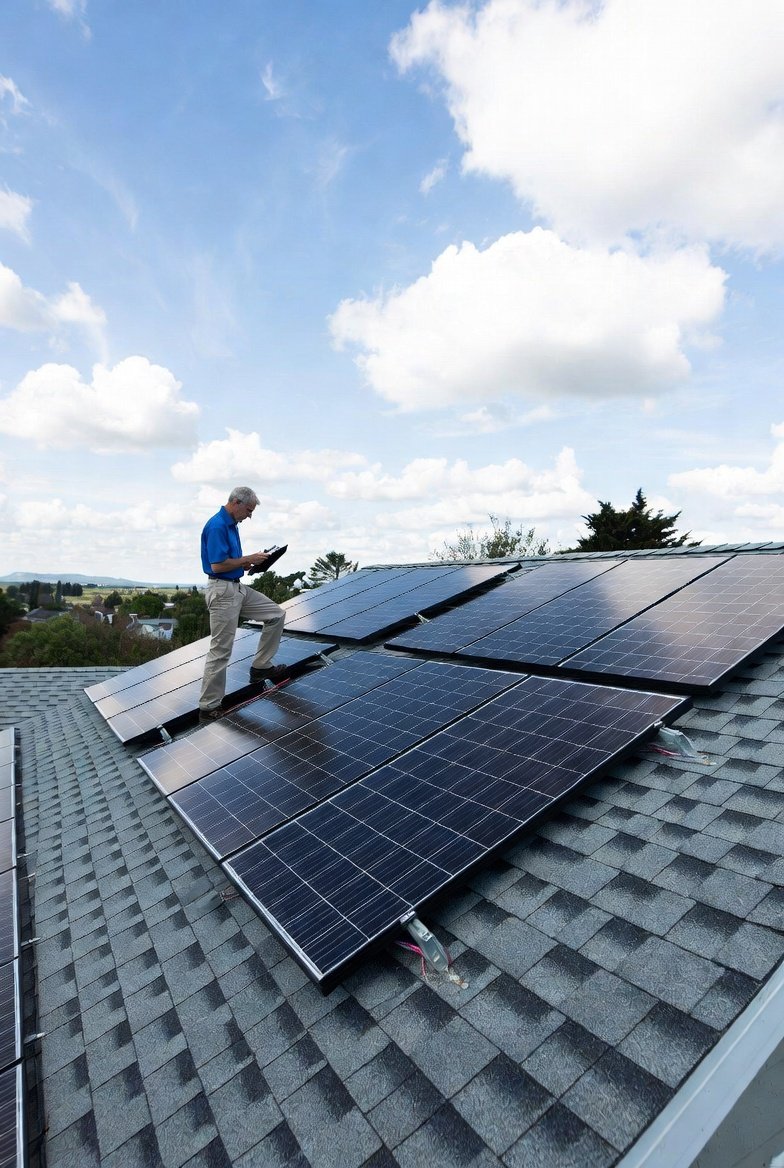
Inspection — Quiet Risk Control
Most inspections confirm something reassuring:
Nothing is wrong.
Professionals typically evaluate:
✔ wiring
✔ mounting hardware
✔ inverter behavior
✔ grounding
✔ connection integrity
Solar reliability often looks uneventful — which is precisely what strong engineering produces.
Installation quality heavily influences this outcome:
Decision Matrix — What Maintenance Exposure Typically Looks Like
System Type | Maintenance Expectation |
Small, simple roof | Very low |
Large residential system | Low–moderate |
Complex roof geometry | Moderate |
Battery-integrated system | Slightly higher oversight |
Severe weather region | Higher inspection awareness |
Context shapes cost far more than averages.
When Maintenance Costs Tend to Rise
Maintenance exposure is often linked to design complexity rather than solar itself.
Expect slightly higher oversight when:
✔ roofs are difficult to access
✔ shading shifts seasonally
✔ electrical routing is complex
✔ equipment quality is lower
✔ monitoring is absent
Strong system design is the single greatest maintenance reducer.
Practical Ways Homeowners Quietly Reduce Costs
Without becoming technicians, owners can support system health through simple awareness.
Annual Visual Check
Look for:
- debris buildup
- new shading sources
- visible wiring damage
No tools required — just observation.
Monitor Production Trends
Unexpected dips deserve investigation.
Trim Nearby Vegetation
Shading increases faster than most homeowners expect.
Small habits often prevent larger expenses.
Storage Changes Lifecycle Planning Slightly
Battery systems introduce additional electronics — sophisticated ones.
While engineered for durability, they expand the infrastructure stack.
Understanding backup strategy clarifies long-term expectations:
Complexity increases modestly — not dramatically.
Insurance — A Quiet Financial Backstop
Some maintenance-adjacent events intersect with homeowner insurance depending on policy structure.
Reviewing coverage early prevents ambiguity later.
Documentation supports smoother conversations.
What Solar Maintenance Typically Does NOT Involve
Balanced expectations protect buyer confidence.
Routine ownership rarely includes:
❌ constant service visits
❌ mechanical servicing
❌ frequent part replacement
❌ ongoing labor contracts
Solar remains one of the lower-maintenance infrastructure upgrades available to homeowners today.
Executive Insight Most Experienced Owners Adopt
Seasoned solar owners stop thinking in annual terms.
They think in lifecycle curves.
When maintenance is distributed across decades, it becomes a manageable financial variable — not an economic threat.
Predictability builds confidence.
Confidence supports adoption.
What This Page Is — And What It Isn’t
This page IS:
- a lifecycle financial guide
- an ownership expectation framework
- a long-horizon planning tool
This page is NOT:
- repair instruction
- contractor selection advice
- technical diagnostics
System design ultimately governs maintenance exposure.
Where Smart Buyers Go Next
Strengthen your ownership model:
👉 Solar Panel System Cost
👉 Solar Panel Return on Investment
👉 Solar Pros and Cons
Financial clarity compounds across connected decisions.
FAQs
Is solar maintenance expensive?
Most homeowners experience relatively low routine costs, though planning for lifecycle expenses — such as inverter replacement — is wise.
How much does solar panel cleaning cost?
Professional cleaning typically ranges from $150–$350, depending on roof complexity and region.
What is the lifecycle maintenance cost for solar?
Many residential systems fall roughly within $2,000–$4,000 over 20 years, though system design influences outcomes.
What is the largest predictable maintenance expense?
Inverter replacement is commonly the most significant lifecycle cost.
Can maintenance reduce solar savings?
Maintenance factors into long-term economics, but many systems still deliver substantial net savings over their lifespan.