
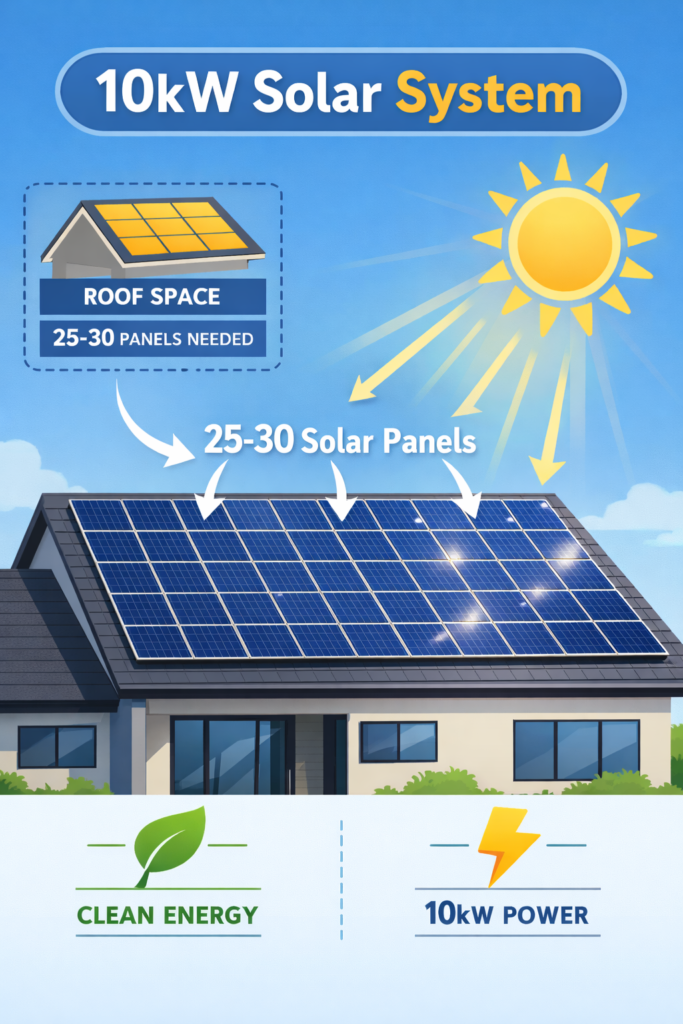
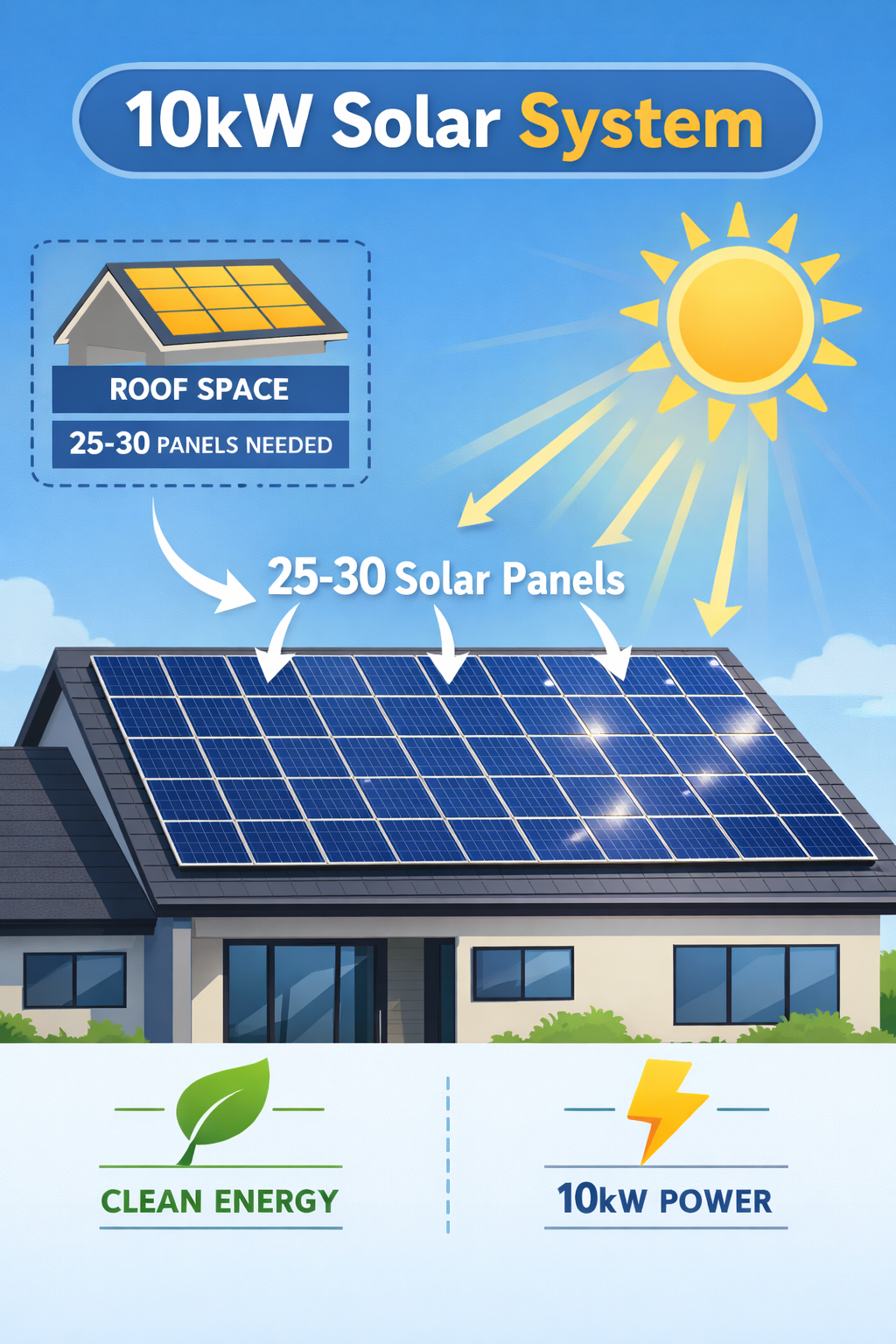
How Many Solar Panels for a 10kW System?
A homeowner planning a 10kW solar installation usually starts with one simple question:
How many panels will that actually require?
Because solar systems are measured in kilowatts while individual panels are rated in watts, the number of panels depends primarily on panel wattage.
With modern residential panels producing 380W to 420W each, a typical 10kW solar system usually requires:
24 to 28 solar panels.
That estimate assumes modern high-efficiency modules and a standard residential design.
However, panel count can vary depending on several real-world factors:
- panel wattage
- roof layout
- shading conditions
- inverter configuration
- system oversizing strategy
Understanding these design variables makes it much easier to estimate how many panels your system will actually use.
Quick Answer: Panel Count for a 10kW Solar System
A 10kW solar system equals 10,000 watts of panel capacity.
Panel count is calculated by dividing system size by panel wattage.
Panel Wattage | Panels Needed for 10kW |
350W panels | 29 panels |
370W panels | 27 panels |
400W panels | 25 panels |
420W panels | 24 panels |
450W panels | 22 panels |
For most modern residential installations using 400W panels, a 10kW system typically includes about 25 solar panels.
Solar production and panel performance are explained here:
/solar-panel-output
The Simple Formula for Calculating Solar Panel Count
Solar panel count can be estimated using a simple formula.
Panel Count Formula
System Size (Watts) ÷ Panel Wattage = Number of Panels
Example calculation:
10,000W ÷ 400W panel = 25 panels
Another example:
10,000W ÷ 420W panel = 23.8 panels
Since panels cannot be fractional, installers round up.
Result:
24 panels
This formula works for estimating any solar system size.
Why Panel Wattage Changes Panel Count
Solar panels have improved significantly in efficiency over the last decade.
Older residential systems used 250–300W panels, which required far more modules to reach the same system capacity.
Panel Generation | Typical Wattage | Panels for 10kW |
Older panels | 250W | 40 panels |
Mid-generation panels | 320W | 31 panels |
Modern panels | 400W | 25 panels |
Higher wattage panels allow installers to build the same system using fewer panels.
This can reduce installation complexity and roof space requirements.
How Much Roof Space a 10kW Solar System Needs
Solar panel size is relatively standardized across manufacturers.
Most residential solar panels measure roughly 17–18 square feet each.
Using this average size, roof space requirements look like this:
Panel Count | Roof Space Required |
22 panels | ~380 sq ft |
24 panels | ~420 sq ft |
25 panels | ~440 sq ft |
28 panels | ~490 sq ft |
Most 10kW systems require approximately 420–500 square feet of usable roof space.
However, roof usability matters just as much as roof size. Panels need:
- strong sunlight exposure
- minimal shading
- proper spacing for wiring and mounting
Solar system layout planning is explained here:
solar-system-design-for-home
How Much Electricity a 10kW Solar System Produces
System size alone does not determine energy production.
Solar output depends on:
- sunlight intensity
- geographic location
- roof orientation
- shading conditions
Typical annual production ranges for a 10kW system look like this:
Solar Resource Level | Annual Production |
Northern states | 12,000–14,000 kWh |
Moderate sunlight regions | 14,000–16,000 kWh |
High sunlight regions | 16,000–18,000 kWh |
Example scenario:
A household consuming 1,200 kWh per month uses roughly 14,400 kWh annually.
In many regions, a properly designed 10kW solar system can offset most of that electricity demand.
System sizing estimates can be calculated using:
solar-system-sizing-calculator
Why Installers Sometimes Use Slightly More Panels
Solar systems are rarely designed to match system size perfectly.
This happens because solar equipment is sold in fixed wattages.
For example:
Using 400W panels:
Panel Count | System Size |
24 panels | 9.6kW |
25 panels | 10.0kW |
26 panels | 10.4kW |
Installers usually choose the closest configuration that meets the homeowner’s energy goals.
Understanding DC vs AC System Sizing
Solar systems include two different power ratings:
- DC system size (solar panels)
- AC system size (inverter output)
It is common for solar panel capacity to be slightly larger than inverter capacity.
Example design:
Component | Rating |
Solar panel array | 10.8 kW DC |
Inverter capacity | 10 kW AC |
This is known as the DC-to-AC ratio.
Oversizing the panel array slightly improves system performance during lower sunlight conditions.
Why Solar Systems Are Sometimes Oversized
Real solar systems experience performance losses.
These losses can come from:
- temperature effects
- inverter efficiency
- wiring resistance
- dust and dirt on panels
Because of these factors, installers sometimes add extra panel capacity.
Example:
A homeowner targeting a 10kW system may install:
10.5kW–11kW of solar panels
This helps maintain strong output throughout the year.
Roof Layout Can Change the Final Panel Count
Solar panels do not always fit neatly onto a roof.
Roof design can influence how panels are distributed.
Common layout types include:
Layout Type | Description |
Single south-facing roof | Maximum production |
East-west split roof | Balanced morning and afternoon output |
Multi-roof layout | Panels spread across different roof surfaces |
Roof geometry often determines the final system configuration.
When a 10kW Solar System Is the Right Size
A 10kW solar system usually fits homes with moderate to high electricity consumption.
Typical electricity usage levels include:
Home Type | Monthly Electricity Use |
Medium home | 900–1,100 kWh |
Large home | 1,100–1,400 kWh |
Homes with EV charging | 1,200–1,600 kWh |
For many households, systems between 8kW and 12kW offer the best balance between cost and electricity coverage.
Real-World Example Scenarios
Different homes may use a 10kW system in different ways.
Example 1 — Efficient home
Annual usage: 11,000 kWh
10kW solar system may cover most electricity consumption.
Example 2 — Larger home with air conditioning
Annual usage: 14,000 kWh
10kW solar may cover 70–90% of demand depending on sunlight conditions.
Example 3 — Home with EV charging
Annual usage: 17,000 kWh
A 12kW or larger system may be more appropriate.
Cost of Installing a 10kW Solar System
Although this article focuses on panel count, system size also affects project cost.
Typical installed pricing for a 10kW system in the U.S. ranges between:
System Size | Typical Installed Price |
10kW solar system | $25,000 – $35,000 |
Solar installation pricing factors are explained here:
solar-panel-system-cost
How to Estimate Panels for Your Own Solar System
Homeowners can estimate panel count quickly using the sizing formula.
Step-by-step process:
- Determine system size (watts)
- Identify panel wattage
- Divide system size by panel wattage
- Round up to the nearest whole number
Example:
10,000W ÷ 400W = 25 panels
This method provides a reliable estimate before receiving a professional solar quote.
Key Takeaway
For most modern residential installations, a 10kW solar system typically requires between 24 and 28 solar panels.
The final number depends mainly on:
- panel wattage
- roof space
- shading conditions
- system design strategy
A professional site assessment helps determine the most efficient layout and system configuration for each home.
FAQ
How many solar panels are needed for a 10kW system?
Most residential 10kW systems require between 24 and 28 solar panels depending on panel wattage.
How much roof space does a 10kW system require?
A typical system requires roughly 420–500 square feet of usable roof space.
Can a 10kW solar system power an entire house?
For homes using around 1,000–1,300 kWh per month, a 10kW system can offset most electricity usage.
What size solar panels are typically used?
Most modern residential solar panels produce 380W to 420W each.