
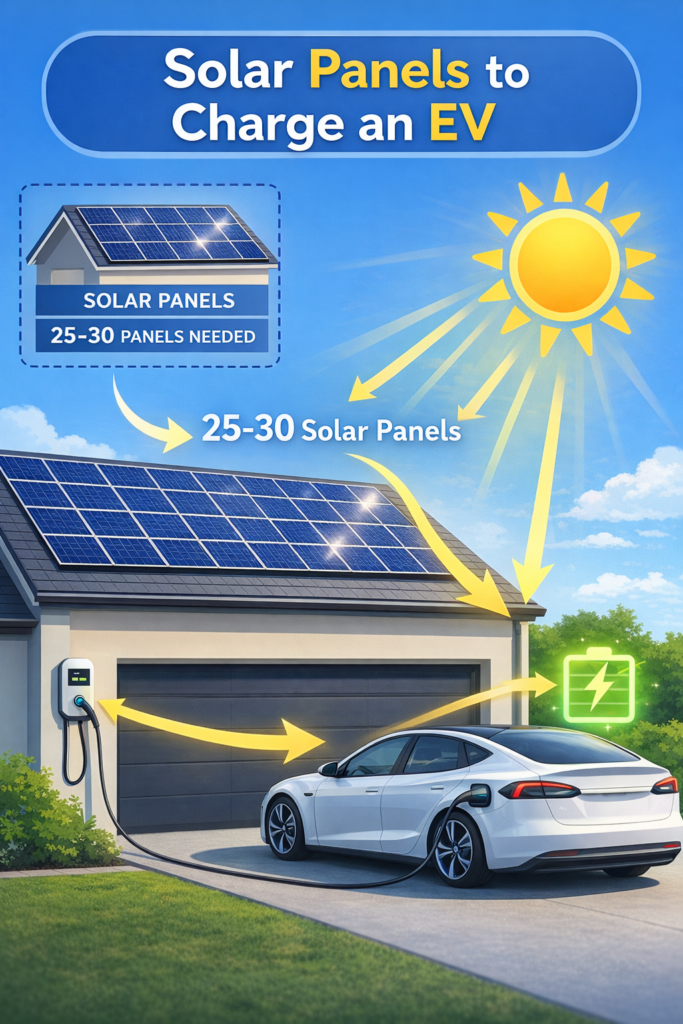
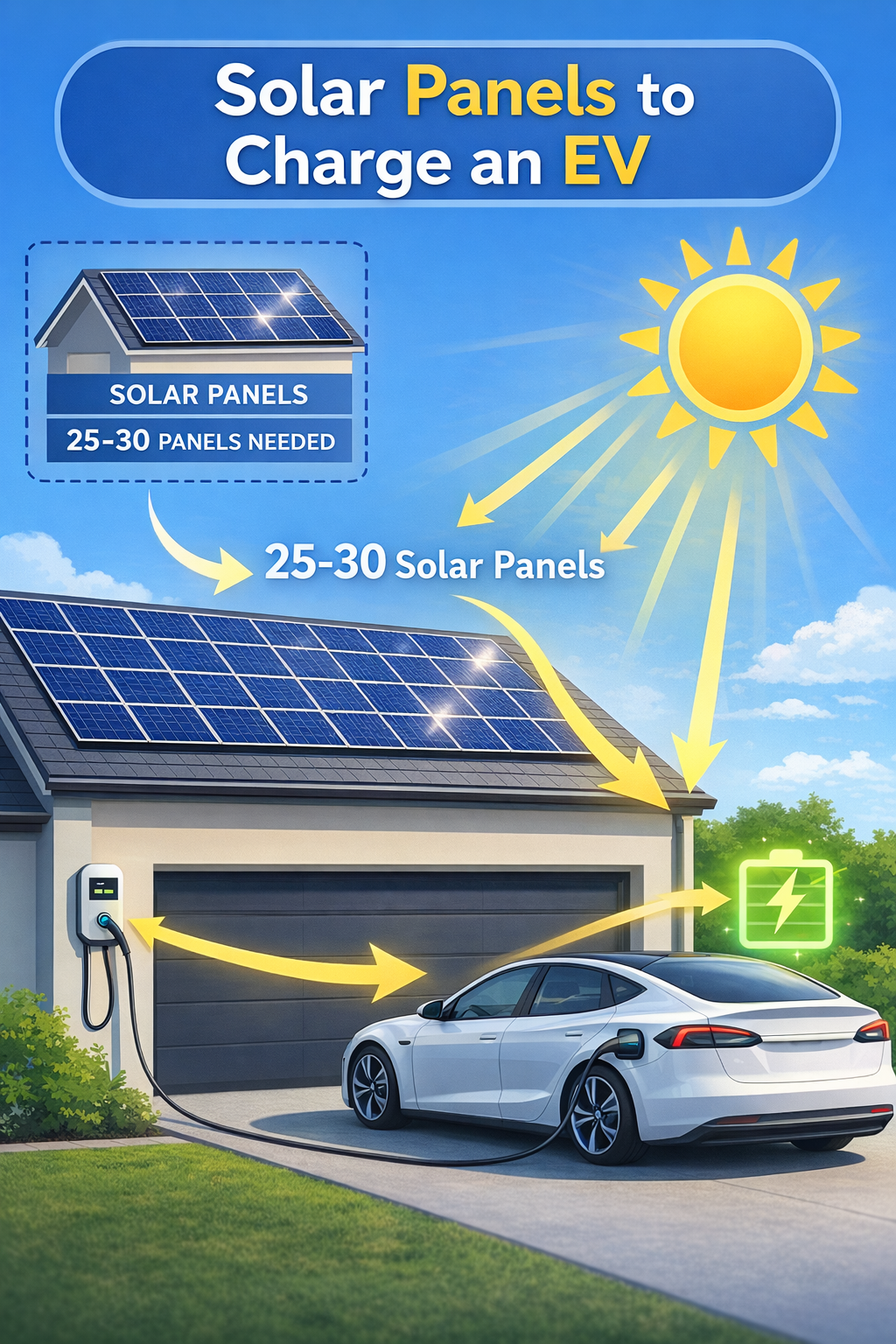
How Many Solar Panels to Charge a Tesla?
Electric vehicles change how households think about energy.
Instead of buying gasoline every week, Tesla owners begin thinking about where their electricity comes from—and for many homeowners, solar panels become the most attractive option.
Charging a Tesla with solar power is completely feasible. But the number of solar panels required depends on a few key variables:
- how far the car is driven each day
- which Tesla model is being charged
- the efficiency of the vehicle
- solar panel output in your location
For a typical driver traveling 30–40 miles per day, charging a Tesla usually requires the electricity produced by 6–10 solar panels.
However, the real number can vary depending on driving habits and solar production.
Quick Answer: Solar Panels Needed to Charge a Tesla
Most Tesla drivers travel about 30 miles per day.
A Tesla typically uses 250–300 watt-hours per mile.
That means daily charging requires roughly 8–10 kWh of electricity.
Modern solar panels generate roughly 1.5–2 kWh per panel per day depending on sunlight.
Daily Driving | Energy Needed | Solar Panels Needed |
20 miles | ~6 kWh | 3–4 panels |
30 miles | ~9 kWh | 5–6 panels |
40 miles | ~12 kWh | 7–8 panels |
60 miles | ~18 kWh | 10–12 panels |
For many drivers, 6–10 solar panels can offset Tesla charging energy.
Solar output calculations are explained here:
Tesla Energy Consumption by Model
Different Tesla vehicles consume electricity at slightly different rates.
Typical efficiency values include:
Tesla Model | Energy Use per Mile |
Model 3 | ~250 Wh per mile |
Model Y | ~270 Wh per mile |
Model S | ~300 Wh per mile |
Model X | ~330 Wh per mile |
Example calculation:
Driving 35 miles per day in a Tesla Model Y:
35 miles × 270 Wh = 9.45 kWh per day
This daily electricity demand determines how much solar energy is required.
Solar Panels Needed for a Full Tesla Charge
Some drivers want to know how many solar panels are needed to charge the battery from empty.
Tesla battery sizes vary by model.
Tesla Model | Battery Capacity |
Model 3 | ~60–82 kWh |
Model Y | ~75 kWh |
Model S | ~100 kWh |
Model X | ~100 kWh |
A typical solar panel produces around 1.7 kWh per day.
Using that estimate:
Tesla Model | Panels for Full Charge |
Model 3 | ~35–48 panels |
Model Y | ~44 panels |
Model S | ~59 panels |
Model X | ~59 panels |
However, most drivers do not charge from empty every day, so the daily solar requirement is much lower.
How Much Electricity One Solar Panel Produces
Solar panel output depends on sunlight conditions and system location.
Modern residential panels typically produce 400 watts.
Average daily energy output looks like this:
Sunlight Conditions | Daily Output per Panel |
Northern states | 1.3–1.5 kWh |
Moderate sunlight | 1.6–1.8 kWh |
High sunlight regions | 2.0–2.3 kWh |
This variation explains why EV solar charging estimates differ between locations.
Solar Miles Per Panel Rule
A useful rule of thumb is estimating how many miles of driving one solar panel can support.
If one solar panel produces roughly 1.7 kWh per day, and a Tesla uses about 0.27 kWh per mile, then:
1.7 kWh ÷ 0.27 kWh ≈ 6 miles of driving
This means:
One solar panel can typically generate enough electricity for about 5–7 miles of Tesla driving per day.
Using this rule:
Panels | Daily Driving Supported |
4 panels | ~20–28 miles |
6 panels | ~30–42 miles |
8 panels | ~40–56 miles |
10 panels | ~50–70 miles |
Annual Driving and Solar Requirements
Average U.S. driving distance is about 13,500 miles per year.
For a Tesla Model 3:
13,500 miles × 250 Wh = 3,375 kWh annually
Solar panels typically generate about 450–550 kWh per panel per year depending on location.
Estimated panel requirement:
3,375 ÷ 500 ≈ 7 solar panels
So about 6–8 solar panels could offset a full year of Tesla driving for many households.
Solar system sizing calculations are explained here:
solar-system-sizing-calculator
Charging a Tesla with a Home Solar System
Most homeowners combine EV charging with their household electricity use.
Example home scenario:
Energy Use | Annual Consumption |
Home electricity | 10,500 kWh |
Tesla charging | 3,300 kWh |
Total electricity demand | 13,800 kWh |
A solar system designed to produce 13,000–15,000 kWh annually could power both the home and the vehicle.
This typically corresponds to systems between 8kW and 12kW.
Solar system design guidance is explained here:
solar-system-design-for-home
Seasonal Solar Output Differences
Solar output changes significantly throughout the year.
Summer months often generate 40–60% more electricity than winter months.
This means:
- EV charging may be fully solar-powered in summer
- winter charging may rely more on grid electricity
Because of this seasonal variation, solar systems are usually sized based on annual production, not daily output.
Should You Install Extra Solar Panels for EV Charging?
Many homeowners installing solar plan for future electric vehicle charging.
Adding a few extra panels can be a practical strategy.
Reasons homeowners oversize solar systems include:
- preparing for EV ownership
- supporting higher daily driving
- offsetting winter solar production drops
- planning for future electric appliances
In many cases, adding 2–4 additional panels during installation is cheaper than expanding the system later.
Charging Speed vs Solar Production
Tesla charging speed depends on the type of charger used.
Charger Type | Charging Power |
Standard wall outlet | ~1.3 kW |
Level 2 home charger | 7–11 kW |
Tesla Wall Connector | up to ~11.5 kW |
Solar panels produce electricity gradually throughout the day, while EV charging may occur overnight.
For this reason, most solar homes remain connected to the grid so electricity can be exported during the day and used later at night.
Cost of Solar Panels for Tesla Charging
If Tesla charging requires 6–10 solar panels, the cost of that portion of a solar system typically falls within this range:
Panels | Estimated Installed Cost |
6 panels | $5,000 – $7,000 |
8 panels | $6,500 – $9,000 |
10 panels | $8,000 – $11,000 |
Solar installation pricing is explained here:
solar-panel-system-cost
Key Takeaway
For typical driving patterns of 30–40 miles per day, charging a Tesla requires the electricity generated by roughly 6–10 solar panels.
The exact number depends on:
- Tesla model efficiency
- daily driving distance
- solar panel output
- local sunlight conditions
Many homeowners install solar systems large enough to power both their home and their electric vehicle.
FAQ
How many solar panels are needed to charge a Tesla Model 3?
For typical daily driving of about 30–40 miles, roughly 5–7 solar panels can generate enough electricity to offset Tesla Model 3 charging.
How many solar panels are needed to fully charge a Tesla battery?
Charging a Tesla battery from empty may require 35–60 solar panels depending on the Tesla model and battery capacity.
Can solar panels fully charge a Tesla?
Yes. A properly sized solar system can generate enough electricity to power both the home and the electric vehicle.
How much electricity does a Tesla use per mile?
Most Tesla vehicles consume roughly 250–330 watt-hours per mile.
How many solar panels are needed to power a house and Tesla together?
Many households require 8kW–12kW solar systems to cover both home electricity use and EV charging.