
How Much Does a 10kW Solar System Cost?
When homeowners research solar installations, the 10kW system size appears frequently because it sits in the range that can power a typical American home with moderate electricity use.
But the price of a 10kW solar system can vary widely depending on equipment choices, roof conditions, and installation complexity.
Understanding the real cost requires looking beyond simple price estimates and breaking the system into its key components.
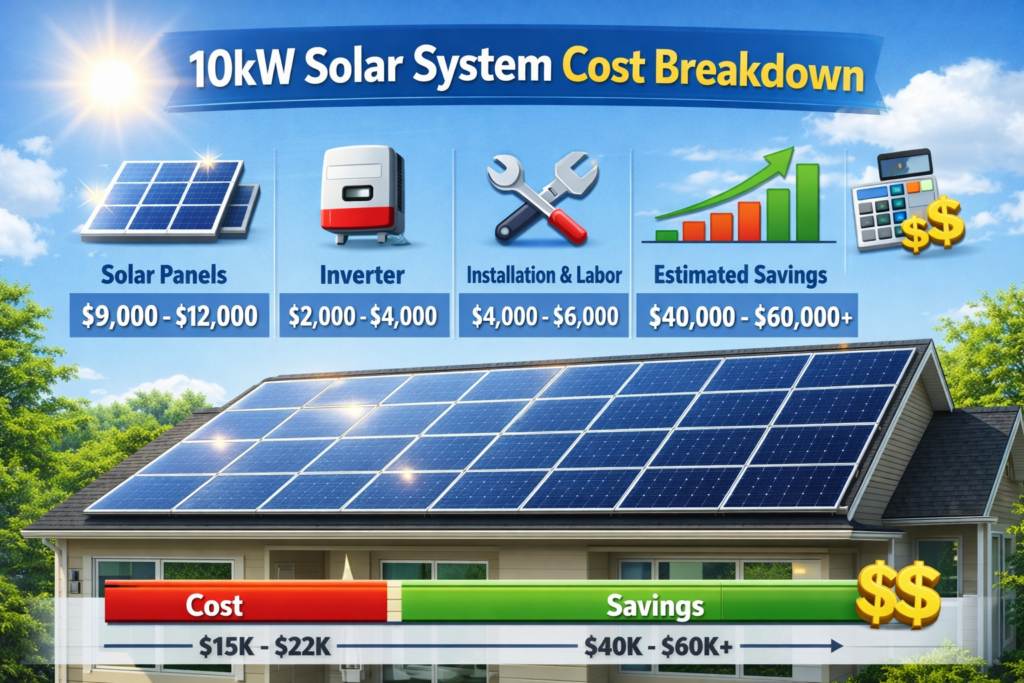
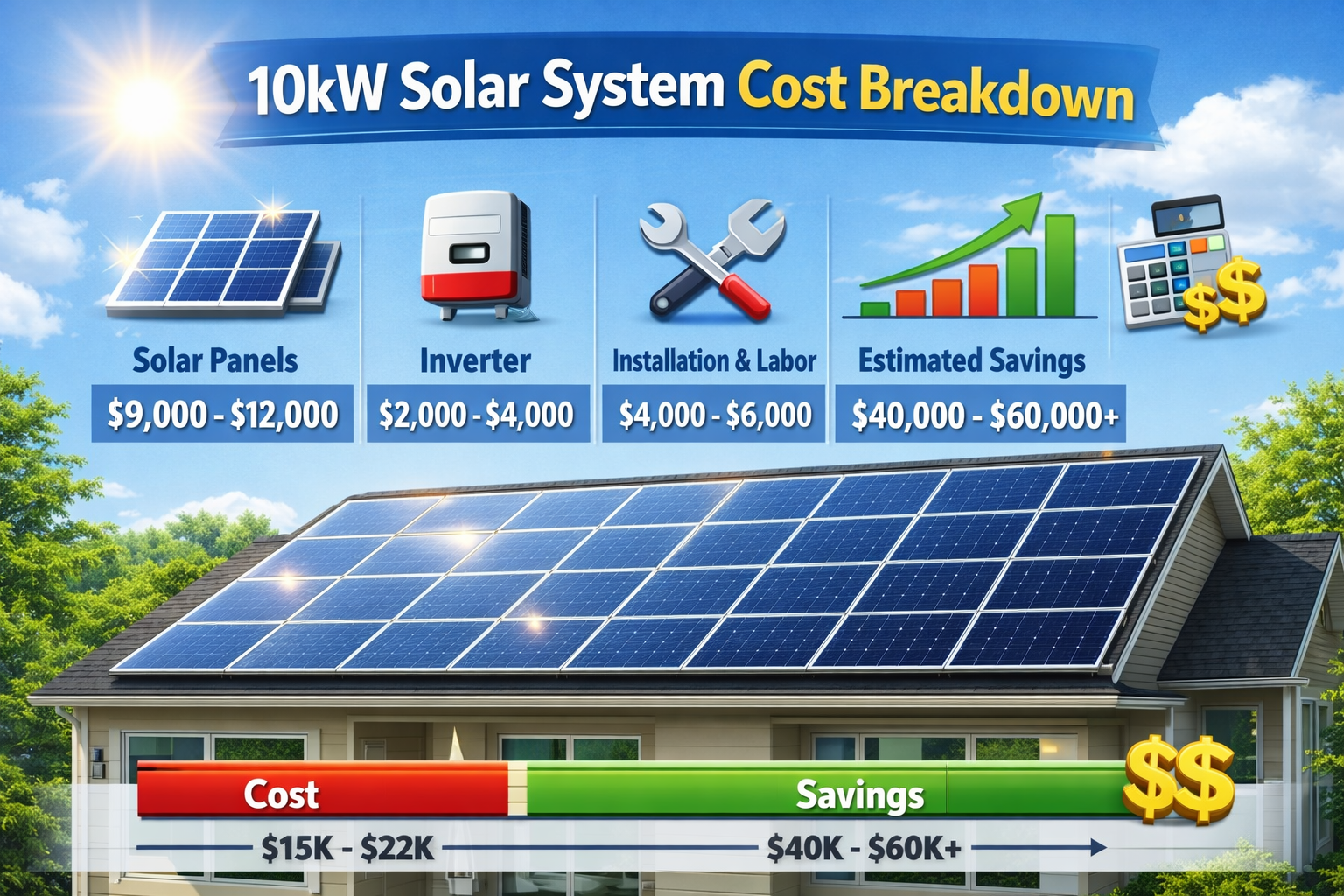
For most residential installations in the United States, a 10kW solar system typically costs between $25,000 and $35,000 installed before incentives.
This range includes the complete installation process:
- solar panels
- inverter equipment
- mounting hardware
- electrical wiring and protection systems
- system monitoring
- permitting and inspections
- installation labor
However, several design factors can move the price higher or lower depending on the home and the installer.
Quick Answer: Cost of a 10kW Solar System
For homeowners looking for a fast estimate, the typical numbers look like this.
System Size | Typical Installed Price | Panels Needed | Roof Space |
10kW solar system | $25,000 – $35,000 | 24 – 28 panels | ~420 – 500 sq ft |
These values assume modern residential solar panels producing roughly 380W–420W each.
Solar production and panel performance are explained here:
solar-panel-output
Why Solar Systems Are Priced Per Watt
Solar installers rarely quote prices only by system size.
Instead, the industry standard is price per watt, which allows different system sizes to be compared fairly.
A 10kW system equals 10,000 watts, so the installed price depends on the installer’s price per watt.
Price per Watt | Total Cost for 10kW |
$2.50 / watt | $25,000 |
$2.75 / watt | $27,500 |
$3.00 / watt | $30,000 |
$3.50 / watt | $35,000 |
Using price per watt allows homeowners to quickly evaluate whether a solar quote falls within the typical market range.
How Many Solar Panels Are in a 10kW System
System size does not directly determine panel count. The number of panels depends mainly on the wattage rating of each panel.
Most modern residential panels produce between 380W and 420W each.
Panel Wattage | Panels for 10kW |
350W panels | 29 panels |
370W panels | 27 panels |
400W panels | 25 panels |
420W panels | 24 panels |
This means most 10kW residential systems contain roughly 24–28 solar panels.
Panel sizing logic is explained here:
solar-system-sizing-calculator
Roof Space Required for a 10kW Solar System
Solar panel dimensions are relatively standardized.
A typical residential solar panel measures roughly 17–18 square feet.
Based on typical panel counts, a 10kW solar system usually requires:
Panels | Roof Space Needed |
24 panels | ~420 sq ft |
25 panels | ~440 sq ft |
26 panels | ~460 sq ft |
28 panels | ~500 sq ft |
Roof orientation, shading, and spacing requirements can also influence the final layout.
Solar system layout planning is explained here:
solar-system-design-for-home
What Is Included in a 10kW Solar Installation
Many homeowners assume the price of solar only includes the panels.
In reality, several components make up the full installation cost.
Component | Purpose |
Solar panels | Convert sunlight into electricity |
Inverter | Converts DC electricity into usable AC power |
Mounting system | Secures panels to roof or ground |
Electrical equipment | Disconnects, wiring, surge protection |
Monitoring system | Tracks solar production |
Permits and inspections | Required by local authorities |
Installation labor | System design and installation |
These components together make up the total system price.
How Much Electricity a 10kW Solar System Produces
Solar energy production depends on sunlight availability and system orientation.
Typical annual output ranges include:
Solar Resource Level | Annual Production |
Lower sunlight regions | 12,000–14,000 kWh |
Moderate sunlight regions | 14,000–16,000 kWh |
High sunlight regions | 16,000–18,000 kWh |
Example scenario:
A household consuming 1,200 kWh per month uses about 14,400 kWh annually.
In many regions, a 10kW solar system can offset most or all of this electricity demand.
Factors That Can Change the Price of a 10kW Solar System
Two homes installing the same size solar system may receive very different quotes.
Several design factors influence the final project cost.
Factor | Impact on Cost | Explanation |
Roof complexity | Medium–High | Steep or multi-surface roofs increase labor |
Panel efficiency | Medium | Premium panels cost more |
Inverter type | Medium | Microinverters increase equipment costs |
Electrical upgrades | High | Older homes may need panel upgrades |
Mounting type | Medium | Ground mounts are more expensive |
These variables explain why solar installation quotes vary between homes.
Understanding DC vs AC System Sizing
Solar systems have two different power ratings.
- DC capacity refers to the total solar panel output.
- AC capacity refers to the inverter output delivered to the home.
Installers often design systems with slightly higher DC capacity.
Example design:
Component | Rating |
Solar panel array | 10.8kW DC |
Inverter capacity | 10kW AC |
This design strategy improves energy production during lower sunlight conditions.
How Much Money a 10kW Solar System Can Save
Solar savings depend largely on local electricity prices.
Example calculation:
Electricity rate: $0.16 per kWh
Annual solar production: 15,000 kWh
Annual savings:
15,000 × $0.16 = $2,400 per year
If a 10kW system costs $28,000 installed, the simple payback period would be:
28,000 ÷ 2,400 ≈ 11–12 years
Solar ROI calculations are explained here:
solar-panel-return-on-investment
Government Incentives and Solar Cost
Government incentives can significantly reduce solar installation costs.
Programs change over time, but incentives can include:
- federal tax credits
- state rebates
- net metering programs
- local utility incentives
Because these policies change periodically, homeowners should confirm current incentive availability before estimating final project cost.
When a 10kW Solar System Is the Right Size
A 10kW solar system typically fits homes with moderate to high electricity usage.
Typical energy use levels include:
Home Type | Monthly Electricity Use |
Medium homes | 900–1,100 kWh |
Larger homes | 1,100–1,400 kWh |
Homes with EV charging | 1,200–1,600 kWh |
Many modern residential installations fall between 8kW and 12kW.
When a 10kW Solar System May Be Too Small
Some households may require larger systems.
Examples include homes with:
- multiple electric vehicles
- electric heating systems
- heated pools or spas
- very high cooling loads
These homes often install 12kW–15kW systems.
Battery Storage and Total Project Cost
Most residential solar installations connect directly to the electrical grid.
Battery storage is optional.
However, adding batteries can significantly increase project cost.
System Type | Typical Installed Cost |
10kW solar system | $25,000 – $35,000 |
10kW solar + battery | $40,000 – $60,000 |
Batteries are usually installed for backup power or energy independence rather than financial savings alone.
Key Takeaway
For most residential installations, the typical cost of a 10kW solar system ranges between $25,000 and $35,000 before incentives.
Actual project pricing depends on:
- equipment choices
- roof layout
- electrical upgrades
- installation labor
- regional solar markets
Because every home has unique conditions, solar installers usually perform a site evaluation before providing a final system quote.
FAQ
How much does a 10kW solar system cost in the U.S.?
Most residential installations cost between $25,000 and $35,000 before incentives.
How many panels are needed for a 10kW solar system?
Most systems use 24–28 solar panels depending on panel wattage.
How much electricity does a 10kW solar system produce?
Typical production ranges from 12,000 to 18,000 kWh per year depending on location and sunlight.
How long do solar panels last?
Most panels last 25–30 years, while inverters may require replacement after 10–15 years.
Is a 10kW solar system enough for a house?
For homes using about 1,000–1,300 kWh per month, a 10kW system can offset most electricity usage.